
Maldivians go to polls in election of president
Maldivians go to polls in election of president
MALE, Maldives - Thousands of Maldivian islanders braved long lines, pouring rain, and glitches in the voting rolls yesterday to cast ballots in the first democratic presidential election in their tiny nation's history.
The vote was seen as a referendum on the 30-year-rule of President Mamoun Abdul Gayoom, who used a burgeoning tourist trade to turn the islands into an economic success story, but has been accused of cracking down on dissent and allowing cronies to dominate the economy.
"He has done a lot, he has really done a lot . . . but now it's time for him to give room for other people to come up," said Ibrahim Zubaya, 52, who works for a mobile phone company.
But voting in this Sunni Muslim nation of 1,190 coral islands southwest of India got off to an inauspicious start, as hundreds of voters found their names missing from the rolls.
Opposition officials accused the government of tampering but insisted the vote must continue. Results were not expected until today.
Mariya Didi, a parliamentarian and chairwoman of the opposition Maldivian Democratic Party, discovered she and her 10 siblings were not on the rolls.
She eventually was told that her registration had been moved to another station, where she voted nearly six hours after she first got in line, she said.
Gayoom's major opponents in the six-person race were Mohamed Nasheed, the charismatic leader of the MDP and a former political prisoner, and Hassan Saeed, a reform-minded former attorney general who is running on the ticket with Shaheed.
If no one wins an outright majority, the two top vote-getters will meet in a run off.
2 American journalists missing in Lebanon
2 American journalists missing in Lebanon

BEIRUT - Two American journalists vacationing in Lebanon have not been heard from since Oct. 1 and are
believed missing, the US Embassy said yesterday, appealing for information on their possible whereabouts.
The two, Holli Chmela, 27, and Taylor Luck, 23, have been working for the Jordan Times, an English-language daily, and had been expected back in Amman on Saturday, according to the chief editor of the Amman-based paper.
The embassy said the two reportedly left Beirut for the northern Lebanese port of Tripoli, a predominantly Sunni Muslim city where militants and Islamic fundamentalists are known to be active. There have been sectarian fighting and bombings in recent months.
Earlier this week, the embassy issued a statement warning its citizens about potential violent actions targeting Americans in Lebanon and calling on them to be more watchful.
Chmela and Luck arrived in Lebanon on Sept. 29 from the Jordanian capital of Amman on vacation and told a friend on Oct. 1 that they were traveling from Beirut to Tripoli through the coastal town of Byblos that day, an embassy statement said.
They then planned to cross by land into Syria before returning to Jordan on Saturday, the embassy said.
Lebanese security officials said they are searching for Chmela and Luck and are trying to ascertain whether they had left the country.
A Jordanian security official said US authorities in Beirut were investigating and that Jordanian authorities are not involved. The officials spoke on condition of anonymity because of regulations and the sensitivity of the issue.
Luck, who is from the Chicago area, has been a reporter at the Jordan Times for the past 18 months.
Chmela, whose last US home was in Washington, D.C., worked as an intern at the English-language daily for three months before leaving the job several weeks ago, the paper's chief editor, Samir Barhoumeh, said. She was a clerk for The New York Times in Washington before leaving earlier this year.
Luck, who speaks Arabic, planned to go to visit the Syrian city of Aleppo after passing through Lebanon, Barhoumeh said, adding that as far as he knows Luck did not enter Syria.
Luck's mother called Barhoumeh on Saturday expressing concern, saying her son did not use his credit card since Oct. 1, he said.
Chmela and Luck left their Beirut hotel Sept. 30 after a one-night stay, the hotel manager Nimr Shalala said. "They checked out, took all their belongings, and didn't say anything," he said.
Russian troops withdraw from Georgia
Dispute over two breakaway areas unsettled
MOSCOW - Russian troops dismantled checkpoints and decamped from Georgia proper yesterday, abandoning a two-month occupation of broad swaths of the former Soviet republic and pushing the conflict to a new status quo.
The withdrawal brings a measure of relief but sheds little light on the bitter dispute over the future of Georgia's two breakaway republics, South Ossetia and Abkhazia.
Russia plans to leave thousands of troops stationed in the rebel regions, which Moscow has recognized as independent states and endowed with Russian passports for residents. Georgia, meanwhile, still aspires to bring the lands back under the control of its central government.
Georgia and the West contend that Russia's plans to leave its enlarged forces in the rebel regions, where it has long maintained peacekeeping forces, violate a French-brokered cease-fire deal. With tensions high, several unsolved bombings have erupted in the breakaway regions.
Yesterday Russia and Georgia were bickering over whether the troops had fully withdrawn.
The move was incomplete because Russian soldiers had not relinquished their grip on the disputed town of Akhalgori, said Alexander Lomaia, secretary of Georgia's national security council. Moscow considers Akhalgori part of South Ossetia.
"All we expect them to do is to quietly withdraw from regions [where] they have never been before, and regions that have never been under any control but the Georgian government's," Lomaia said in a telephone interview. "Unless they withdraw . . . we are not able to concede that they have met the Oct. 10 deadline" set by the cease-fire accord.
Shota Utiashvili, a spokesman for the Georgian Interior Ministry, said the Russian withdrawal was a positive move, but he added that Georgia would not consider it complete until the troops leave Akhalgori, as well as the Kodori Gorge in Abkhazia.
"We think that it's a step in the right direction, but it doesn't mean yet that the withdrawal is fulfilled," Utiashvili said.
Moscow considers the Kodori Gorge part of Abkhazia, a claim that Georgia rejects.
Russian officials made it plain yesterday that, in their view, the withdrawal was finished. General Marat Kulakhmetov, who is in charge of Russian troops near South Ossetia, said the pullout had been fully completed, according to Russian news reports.
Earlier yesterday, President Dmitry Medvedev said Russia's pullout from areas outside South Ossetia and Abkhazia would be completed by midnight.
"It is now important to calm down and at least to give up the confrontational rhetoric," Medvedev said at a conference in Paris. "Nothing fatal or irreparable has happened. A new edition of the Cold War is not threatening us."
A European Union monitoring commission would not confirm that Russia had withdrawn from all of Georgia proper. But the panel's head, Hansjorg Haber, called the Russian pullout a positive development."
In Washington, the State Department also welcomed Russia's moves but said it was watching to see whether it completed the withdrawals by the deadline.
Under the French-brokered deal, Russian forces have until tomorrow to abandon posts on land seized during the summer war. The soldiers had been controlling a rural run of villages and farmlands following a five-day conflict in August that cranked up tensions by pitting US-backed Georgia against Russia.
The conflict began on Aug. 7, when Georgia launched an operation to bring South Ossetia to heel. Russia intervened with a punishing land and air assault. At the height of the offensive, Russian troops sent tanks well into Georgia proper to within 25 miles of Tbilisi, the capital.
The Russian soldiers later pulled back but kept a tight grip on the "security zone" abutting South Ossetia and Abkhazia, which have been largely autonomous since the early 1990s.
Russia went on to recognize the independence of the breakaway republics.
Georgia is expected to demand that Russia leave the breakaway republics during a European Union-sponsored conference in Geneva next week.
But Moscow is unlikely to comply.
Bush signs nuclear deal with India
Bush signs nuclear deal with India
WASHINGTON (CNN) -- President Bush signed into law the lifting of a ban on nuclear trade with India.

U.S. President George W. Bush signs into law the lifting of a ban on nuclear trade with India.

"This agreement sends a signal to the world: Nations that follow the path of democracy and responsible behavior will find a friend in the United States of America," Bush said at the signing ceremony for the U.S.-India Civil Nuclear Cooperation Agreement.
Trade of nuclear supplies with India, the world's largest democracy, was banned when the South Asian country tested an atomic bomb 34 years ago.
The Senate voted last week to overturn the ban. The House of Representatives later passed the bill without debate.
Secretary of State Condoleezza Rice has called the deal "a historic agreement" that put the United States and India on a "firm footing."  Watch what the deal entails »
"What the civil nuclear deal does is that it removes, for India, a barrier to full integration on a whole range of technologies," she said.
"But more importantly, I think it is symbolic of a relationship with India that's now at a very, very different level. And at that different level, one would expect that economic relations, defense relations, a whole range of relationships, including business relationships, will flourish."
The agreement means American businesses can sell nuclear fuel, technology and reactors to India. In return, India will allow international inspections of its civilian -- but not military -- nuclear power plants. It also promised not to resume testing of nuclear weapons.

The United States banned nuclear trade with India after it exploded a nuclear device in 1974 and refused to sign the nuclear Non-Proliferation Treaty.
Critics contend that the agreement Bush signed would hurt international efforts to keep nuclear weapons from spreading.Losing female support, McCain alters approach
Losing female support, McCain alters approach
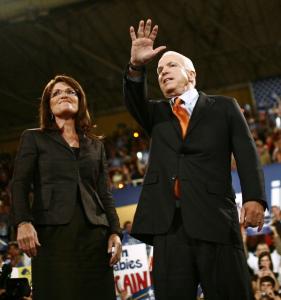 | John McCain and Sarah Palin held a rally yesterday in Bethlehem, Pa. Polls indicate the candidate has lost any gains he made among women by making Palin his running mate. (Gerald Herbert/ Associated Press) |
BETHLEHEM, Pa. - Senator John McCain returned to the campaign trail yesterday with new emphasis on a domestic agenda that appeared designed in part to address the concerns of white women, a crucial voting bloc that has moved steadily in recent weeks toward his rival, Barack Obama.


After his second debate with Obama on Tuesday night, McCain and running mate Sarah Palin held events in Pennsylvania and Ohio where he stressed healthcare and homeownership - both issues that women, especially independent white women, have cited as important in their choice of a candidate.
"The dream of owning a home should not be crushed under the weight of a bad mortgage," McCain said at a rally here at Lehigh University, where he began his speech with remarks about a new proposal to bail out homeowners carrying underwater mortgages.
Obama has built up support among women that approaches the level of female support for the last successful Democratic candidate, Bill Clinton, when he won his second term in 1996. In both the presidential races that followed, George W. Bush made inroads among women voters that helped him defeat successive Democratic challengers.
Republican officials now are looking for ways to bolster homeownership - and have recognized the issue's political appeal to women.
"It's a pressing issue for all of us, and especially independent female voters," said Republican National Committee chairman Mike Duncan.
And two McCain aides who were trumpeting the plan, under which the Treasury Department would spend $300 billion to buy up mortgages and renegotiate their terms, volunteered that it was modeled on a similar plan proposed by Senator Hillary Clinton in the Democratic primaries.
After remaining silent on the plan during Tuesday's debate, Obama yesterday came out against McCain's mortgage proposal, claiming it would be too costly to taxpayers. "The biggest beneficiaries of this plan will be the same financial institutions that got us into this mess," policy adviser Jason Furman said in a statement.
Even though healthcare is not directly connected to the financial crisis, both candidates have been speaking about their health proposals in recent days, an issue that aides for both campaigns say resonates particularly strongly with women. The turn was particularly novel for McCain, typically more comfortable talking about fiscal and taxpayer concerns.
"On healthcare, people got a better understanding of how our healthcare plan differs from Senator Obama's, and it's an area of tremendous interest to women," said McCain strategist Charlie Black.
Public and private polling indicates that McCain has lost any gains made among women since late August when he chose running mate Palin, the Alaska governor who now appears more popular among men than women.
Much of the initial fascination with Palin, the first female Republican vice presidential nominee, has been overshadowed by economic news.Continued...